















Flags from various countries wave in the air. Children dance and sing as they hold flags from places all across the world, from Australia to the United Kingdom, to India, to Malaysia. Cloè Knight sits back, watching students from different lands and cultures coming together to celebrate and honor the diversity that makes up Australia, feeling grateful to be a part of this moment during Harmony Day.
“I was just sitting there, seeing all the little flags and all the kids, and just thinking about,” Knight said. “How lucky I am that I got to do this, and got to be here and see this. And also just how awesome it is that a country does this. And this is how Australia views over countries with inclusivity and beauty, you know, like they’re teaching their kids to do this.”
Knight, a USM senior special education major, with a minor in English. always knew she wanted to be a teacher. From a young age, she played teacher with her stuffed animals, using an EZ grader that she begged her mom to buy after seeing her own teacher use one.
Her original plan was to become an English teacher. However, after working at a camp known as Center Ridge Outpost, or Camp Kaleidoscope, which works with autistic children, Knight realized she wanted to go into special education.
Becoming a teacher was never a question for Knight. But the dream of her teaching abroad was less certain. It was one of her biggest dreams since she was in high school, but the challenges, such as travel costs, living expenses and certification not being transferable, made it difficult to achieve.
Through the Consortium of Overseas Student Teaching program, Knight was able to turn her dream into a reality. The COST program enables students to complete their student teaching semester abroad while gaining teaching experience in another cultural setting.
After learning that her scholarships could be applied to the program and that she would be placed with a host family, solving the problem of finding housing, the choice was easy. Knight stated that the decision was a “no-brainer,” saying that she knew she had to take the opportunity if she was accepted.
Once accepted, Knight selected four countries that she wanted to be placed in: Greece, New Zealand, Ireland and Australia. While she would have been happy in any of them, the one that she really wanted to be in was Australia, and it was the one that she received.
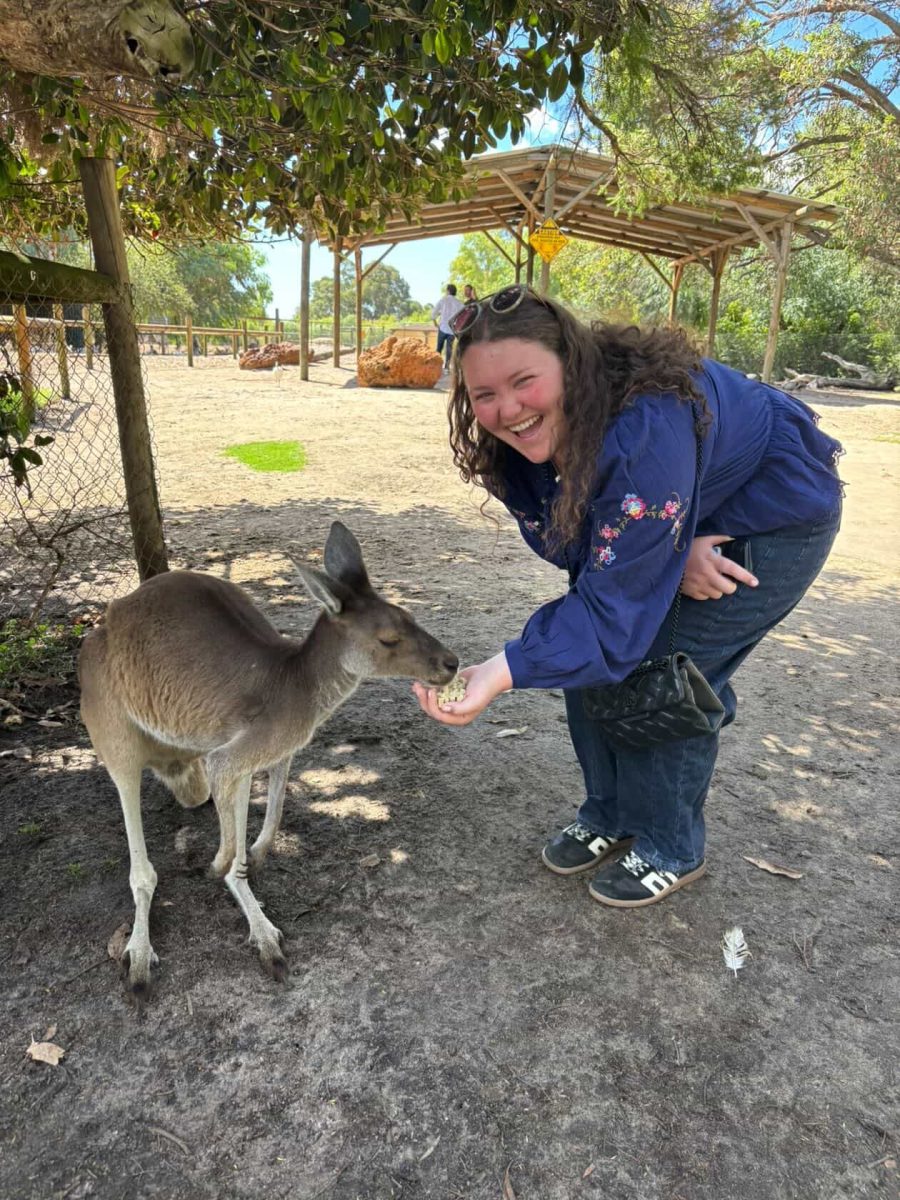
In March, Kight made her journey to Perth, Australia, where she began working with Cloverdale Education Support Center with her mentor teacher, Jess Richardson, teaching year two students, which is the same as second graders in the US. She is also living with her host mother, Manuela, who has shown her everything there is to see in Perth and has taken her under her wing, becoming like a mother to Knight.
This opportunity has allowed Knight to grow both personally and professionally. While the program is designed to help students grow and develop their skills as teachers, this experience has also pushed Knight to grow personally as well.
Despite having never traveled solo or even to another country before, Knight spent three days exploring Sydney on her own before arriving in Perth.
Landing in Sydney filled her with awe, realizing she was truly in Australia. That excitement was quickly followed by the dread of realizing that her phone didn’t work. But thanks to preparation from her father, she was able to get a SIM card and resolve the issue.
Having previously only ever visited cities as big as New York, and landing in a city 10 times larger than even that, Knight navigated the city on her own and visited all the landmarks she wanted to, such as the Sydney Opera House, taking a ferry to Manly and exploring the botanical gardens. The experience that taught Knight independence and confidence.
“I’ve definitely become hyper independent because I’ve had to do so much on my own. Those little three days in Sydney taught me so much about myself. I didn’t even know. I genuinely think that’s the proudest of myself I’ve ever been. That I was able to do that and pull that off,” Knight said. “I’m just proud of myself for being so independent and I’ve definitely grown.”
Knight has made a lot of personal growth through her journey navigating Australia, having grown both inside and outside the classroom.
After her stint in Sydney, she arrived in Perth, her home for the next two months. Before this experience, Knight was one to always stick to the plan, having described herself as a “huge planner” who always wanted everything to be perfect. But through her time teaching abroad, she has changed that mindset.
“There’s just things that you can’t plan for, especially in special ed,” Knight said. “This has just taught me to be a lot more spontaneous and just to like go with the flow a lot more.”
She said that even if she always knew that this field was unpredictable, but being in Australia has taught her valuable lessons of how to be more flexible.
“Learning to be more flexible and more independent,” Knight said. “It’s taught me like it’s okay for your plans not to go perfectly.”
One of the biggest differences between the two countries is the special education system. In the United States, special education focuses on inclusion, with many students placed in general education classrooms and pulled out to work with SPED teachers. In Australia, however, most special education students attend specialized schools.
“It was just like crazy to see the difference, honestly,” Knight said. “Just so different. Like just the structure of the day is a lot different, the things that they used, like the strategies they used to teach, is a lot different. So yeah, I’ve learned A lot. Even their sign language is different.”
At her school, Knight begins the day by greeting students and helping them unpack their bags. Students start by participating in morning fitness led by an instructor, a schoolwide activity in which all the students will go outside and work with a fitness instructor on what Knight referred to as a very cute, choreographed fitness dance to music.
The day continues with morning circle and structured learning activities using the TEACCH system, which focuses on visual learning, routine and individualized instruction. Following that, students will also enjoy iPad time and other activities such as puzzles, then they will go on to attend recess, which they call “morning tea,” lunch ad nap times, before they finish out the day with iPad time.
“Cloé has jumped straight into Orange Room and has felt like part of the team from day dot. She’s always keen to jump in and support all students and shows real strength in the way she connects with them and speaks at their level. She gives everything a crack! Even trying Vegemite at breakfast club,” Richardson said. “She brings great energy to the room, always joining in with songs and laughter. She’s learnt the AUSLAN Acknowledgement of Country for the Whadjuk Noongar people and practices it every day, showing real commitment and genuine respect for the cultures within our classroom and wider community.”
With the help of her teaching mentor, Richardson, Knight has been able to learn many valuable lessons and strategies that she will be able to implement within her own classroom one day. From previously unknown strategies to valuable lessons such as management strategies that can only be gained through working with other teachers in the classroom.
“I’ve learned the most from her is like behavior management, like really good behavior management in the classroom and how instruction is not effective if behaviors are going crazy,” said Knight. “We have to deal with the behaviors first, then we can continue instruction.”
Knight has learned many new skills and techniques during her time abroad, including Australian Sign Language, known as Auslan, and the TEACCH system. A learning strategy that, despite being an American system, Knight had never heard of before. The system supports special education students to improve their fine motor and foundational skills, encouraging independence and social and emotional growth through visual learning, structure and routine.
“It’s taught me so many strategies to use in the classroom that we don’t use in America,” Knight said. “Strategies that are evidence-based that I can implement in the classroom…bringing things that I’ve learned from here back home.”
While Knight has enjoyed getting to see the sights, traveling to another country and learning new ways to improve her skills as a teacher, none of them can compare to the moments she spends with her students.
One of her favorite moments within the classroom was helping a student spell his own name with an alphabet puzzle and watching him do it by himself three days later. It is moments like these that reinforce her passion for teaching.
“I mean, it’s just those little things like that whenever they can, pick up on it,” she said.
Watching as the students pick up on what is being taught to them means a lot to Knight. She also mentioned how she saw another student who was nonverbal but began joining in on their daily goodbye song.
“That’s a big win, you know, that he’s started picking up on that. So just those little things like that, that probably don’t mean a lot to other people, that’s huge for them.”
In the future, when Knight says she is 80 years old, she will remember these experiences as being one of the coolest things she has ever done. She has spent this trip being grateful every day for getting the opportunity to follow her dreams of teaching abroad in another country, seeing places that are taken straight out of a postcard.
She has enjoyed her time in Australia, but as the home sickness has begun to kick in, Knight is looking forward to her return home in three weeks. And while she will miss the people, she has meet and the food that she has found a love for, such as Lamington’s ad Tim Tam’s, she is looking forward to returning to her friends, family and the chance to spend her summer preparing her classroom at Leakesville Elementary School, where she already has a job lined up and ready for her return.
“Just having that positive influence in a child’s life is so important, for their development and for who they’ll become,” Knight said. “So, as teachers getting to be a part of that, even if it’s a small part of it, that’s so special.”