






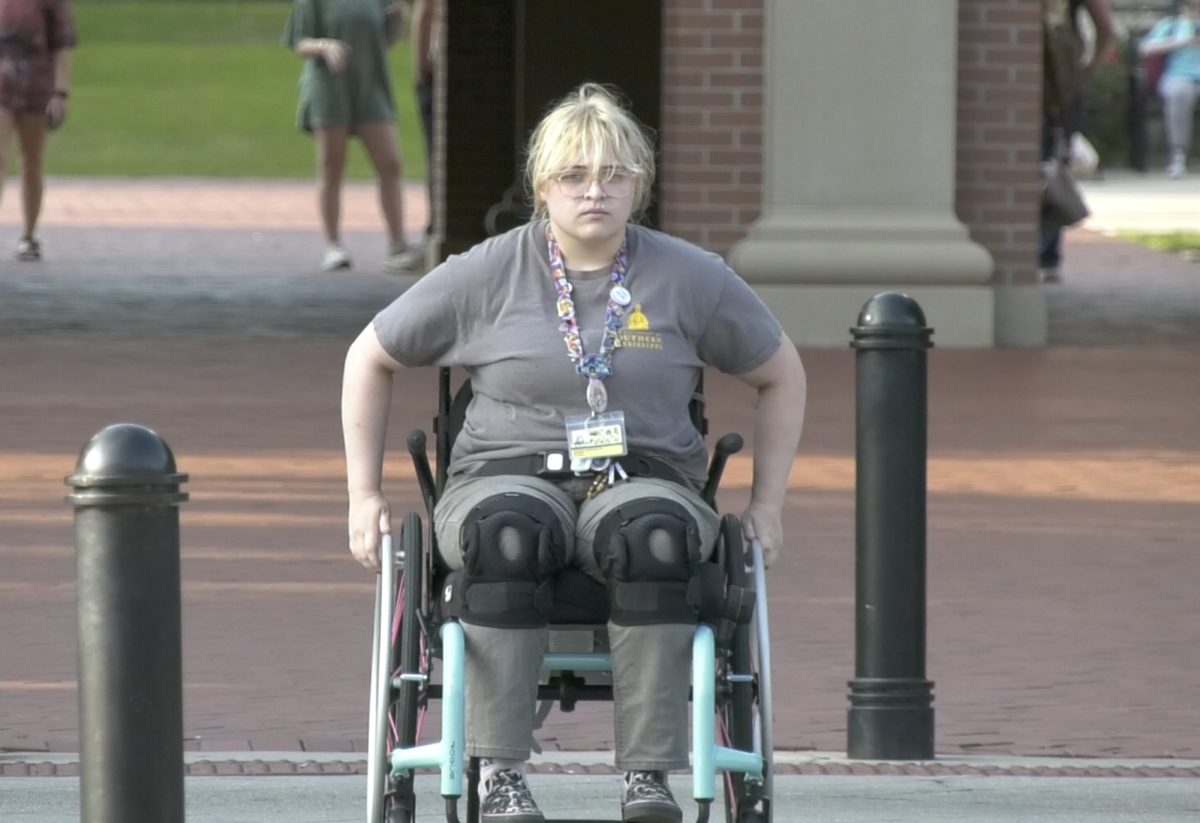
A University of Southern Mississippi student is working to change perceptions about disabilities while managing several health conditions of his own.
Kaden Burkhalter says his college experience looks different from many of his peers, but he remains determined to succeed academically and socially. Burkhalter lives with multiple conditions, including Hypermobile Ehlers-Danlos syndrome, also known as hEDS, a disorder that affects connective tissue and can make everyday movement difficult.
“All of my connective tissue degrades faster than the average person,” Burkhalter said. “Some of them I was born with them already degrade and my knees don’t work without braces, so I have to wear them to keep me from dislocating my kneecaps.”
In addition to hEDS syndrome, Burkhalter also has an essential tremor, which impacts his ability to write and participate in certain activities. He said the tremor may be linked to the placement of his brain.
“Part of my brain is sagging below where it needs to be,” he said. “It’s possibly why I have the tremor and it applies pressure to my spinal cord.”
Burkhalter also lives with Postural Orthostatic Tachycardia Syndrome, Tourette syndrome, Gastroparesis, and Scoliosis adding to the challenges he faces daily.
Despite these obstacles, Burkhalter uses social media to share his experiences and educate others. His videos highlight how he navigates everyday tasks and provides information about his conditions.
He said his goal is to help others feel less alone.
“I want people to know that they can still have a good life and a community,” Burkhalter said.
His best friend, Alex Starnes, said people often make assumptions about Burkhalter’s capabilities.
“He doesn’t like it when people assume what he can and can’t do,” Starnes said. “Inviting him anyway or asking questions is a lot better than assuming and he’s open to explaining his conditions to others.”
Burkhalter receives support through the university’s Student Accessibility Services, which provides academic and housing accommodations.
He want’s people without conditions to understand he’s not afraid to answer questions about his health and isn’t completely different from his peers.
“People with conditions, we’re really not that different,” he said. “We’re human. We want to have friends and talk to people, but because people are afraid they’re going to offend us, it isolates us even more.”
Burkhalter hopes his story encourages others to approach people with disabilities with understanding and openness.
He said with the right support and determination, students with disabilities can succeed and redefine what achievement looks like both in and out of the classroom.