







In 1888, the Roundhay Garden Scene became the first motion picture, a 2.11 second clip of people walking through a garden. It was a technological achievement: proof that movement could be captured and replayed.
But somewhere between that experiment and the films we watch today, cinema stopped being just technology. It became a language.
“Film is a language,” said Vincenzo Mistretta, professor of film studies at the University of Southern Mississippi. “You have to learn how to speak with it.”
For Mistretta, cinema is about communicating through visual elements: composition, color theory, movement and rhythm. Dialogue and music come later. All the different arts, he argues, are incorporated within cinema’s visual grammar. Hence, a good filmmaker is a good visual storyteller.
Because filmmaking is a language, anyone can learn it. The skills can be taught; what matters most is passion and discipline.
“You could study French and you can learn French,” Mistretta said. “Eventually you’ll be good at it, I think it’s the same for filmmaking.”
At USM, the film studies program is built around that premise. If cinema is a language, then filmmaking isn’t about innate talent, it is about learning grammar, practicing techniques, and discovering the voice. That philosophy shapes everything about the program: how it’s structured, what students create, and how they discover their path in filmmaking.
The film studies program is a two-year sequence within the four-year degree. Most students complete their first two years at USM’s Hattiesburg campus or at community colleges before transferring to the Gulf Park campus, where the program is based.
USM’s approach to teaching filmmaking is holistic. Rather than specializing immediately, students learn every aspect of filmmaking: writing, directing, cinematography, editing, and sound design. By graduation, students have discovered which role suits them best.
“We’re educating a filmmaker, not a director or cinematographer,” Mistretta said. “When you get in here and you start working with all these different parts, you’ll find that passion.”
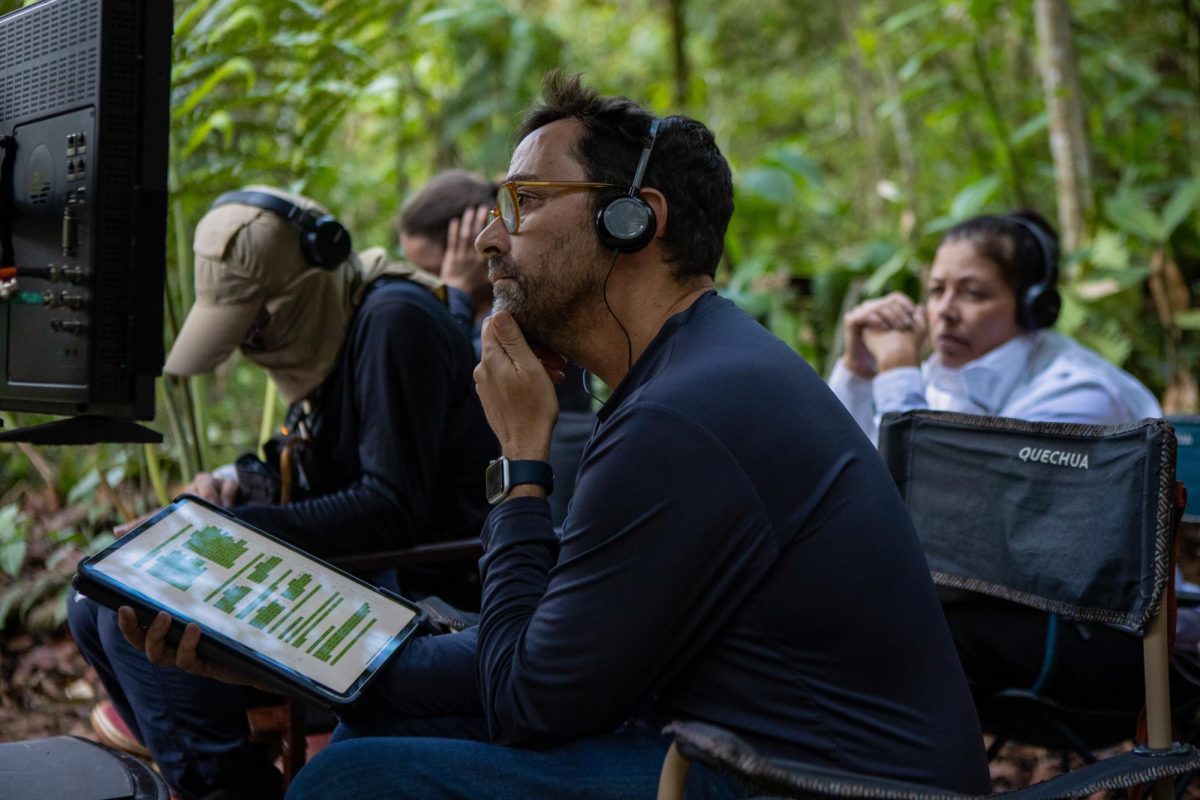
The curriculum balances film history and theory with hands-on production. Students study genres, analyze classic films and learn documentary techniques. On the production side, they learn costume and set design, sound design, building sets and directing, then apply those lessons by making their own films.
All of which starts with the first film students have to make in their junior year, which has no dialogue, emphasizing the program’s philosophy of visual storytelling. The program also teaches reasoning behind the filmmaking choices, the technical ‘why’s that a self-taught filmmaker might miss.
“Anyone can learn how to set up a light,” said Mistretta. “But if you go to school, you understand more broadly how that light affects the image.”
The program aims to introduce every aspect of filmmaking to the students, who then discover their passions and what they hope to pursue in the future.
“I open up the door behind the magic and tell you how the magic is put together,” said Mistretta. “And I see them really being very much in awe when they put it together.”
Students also participate in real-world productions they can add to their resumes. For example, they created a documentary for the Infinity Science Center when an Apollo-era booster rocket was relocated from NASA, and they also produced multi-camera videos for a YouTube channel featuring interviews with researchers.
“I’ve tried to get as many different projects outside of class where students get more experience. It’s all about experiential learning,” Mistretta said.
Those experiences, Mistretta explained, often shape the careers students pursue after graduation. Some of his students have leaned into editing or cinematography, while others have moved into set design, the art department, or camera assisting on professional sets. A handful have stayed local and worked in TV production at stations like WXXV or WLOX, while others found opportunities in Atlanta’s growing film scene or at film rental houses. Some graduates took a more independent route, creating commercial work or running small production companies, while a few moved into YouTube production or festival work. And every now and then, someone makes it all the way to Hollywood: directing, producing, or even winning awards in areas like costume design.
However, the program faces challenges as well. Right now, it has only two faculty members and 18 students. The numbers haven’t recovered since COVID-19, when the classes typically held 30 to 40 students. Mistretta says the program could grow with an additional faculty member, which would allow it to expand into areas such as animation, documentary filmmaking and virtual production.
“I would love to add a third faculty, so that we could expand,” he said.
In the meantime, Mistretta keeps teaching the language he loves, one frame at a time. And for the students who walk into his classroom, that’s often enough, because once they can “see the magic,” as he puts it, many of them never look at film the same way again.