













The University of Southern Mississippi is displaying artworks from a local art collective in a group exhibition centered on the theme of community connection.
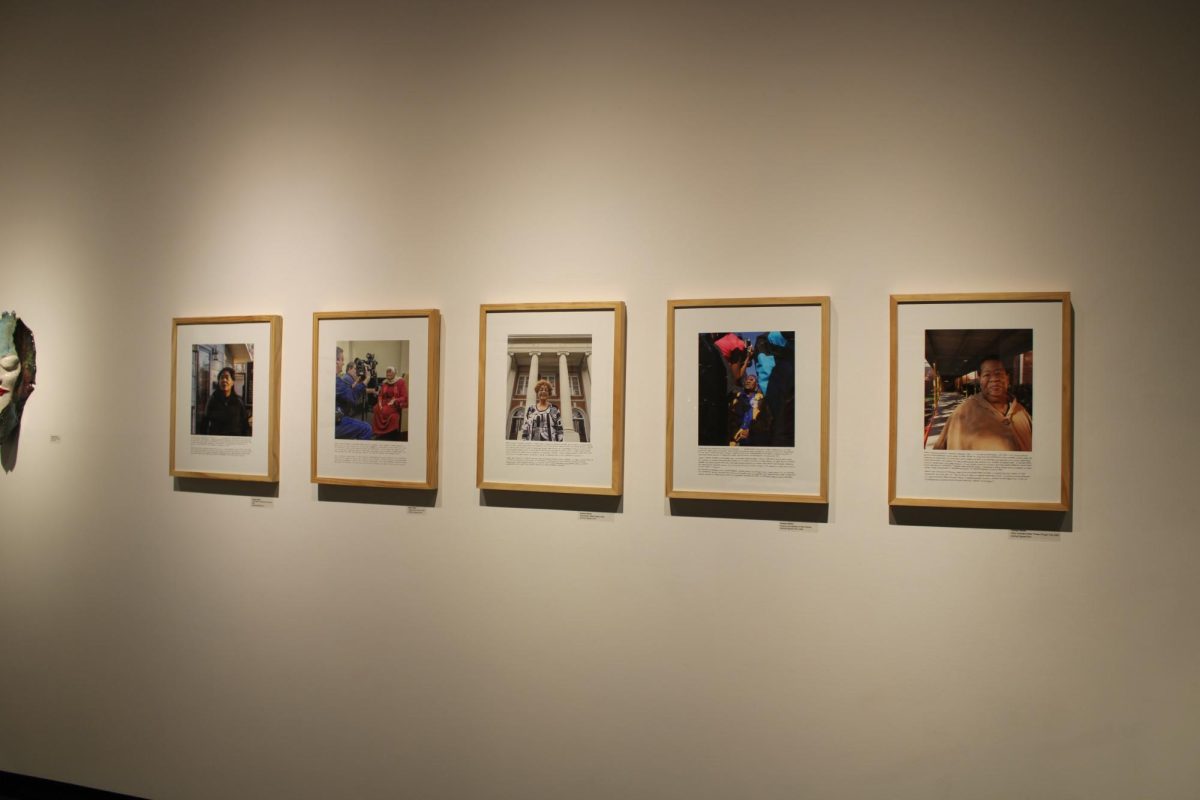
Walking into the exhibition, a wide array of art is on display, from paintings to sculptures, each meant to showcase a sense of connection within the Hattiesburg community. On a wall just to the left of the entrance, under bright display lights, are photographs of five women who represent the history of our community.
The women are connected not only through the community they call home, but also through their will to fight and desire for change. The photographs serve as a reminder of the community’s history, telling the stories of five women whose efforts helped shape it.
Betty Press and Carolyn Norton are members of the Hattiesburg Women’s Art Collective and owners of some of the artwork currently on display. The collective is an invite-only group consisting of around 15 artists from the Hattiesburg area.
Alongside their work with the collective, Press and Norton collaborated on a large-scale photographic project known as The Yellow Rose Project. For the project, they photographed five women who played key roles in improving voting rights for Black women in Hattiesburg.
“We had to all decide what we’ll put into the show,” said Press, co-founder of the Hattiesburg Women’s Art Collective. “Carolyn really had the idea that she wanted to do this, and I’m so glad because it is the perfect one for this show at USM. Peggy got her honor, her award here, they are all active in the community, so it just reflected the theme: connected to community.”
The women featured in the photographs are Peggy Jean Conner, Doris Townsend Gaines, Ellie Davis Dahmer, Lillie Dwight and Ruby Wilson. Each played a role in the fight for voting rights in Hattiesburg. The photographs not only honor their courage but also highlight their shared connection to the community.
“It means so much to the community because it represents that history should never be forgotten and how much empowerment that the women have upheld while trying to get the voting rights here,” said Reese Wesley, junior majoring in speech pathology and ideology.
Wesley referenced Dahmer, who was a founding member of the Beta Chi Sigma Chapter of Sigma Gamma Rho, Wesley’s sorority.
“Personally, knowing someone and knowing how much she has fought even after her husband has passed away, it just shows how much stronger they are even to this day.”
Underneath each photo of the women is a handwritten note describing the impact the women had, along with a quote and the location where the photograph was taken.
Each location was chosen for the personal significance connected to the women. Gaines’ photo was taken outside the school where she graduated and later wrote a book about. Dwight was photographed in front of her childhood home, which Dr. Martin Luther King Jr. visited during his stay in Hattiesburg. Wilson was photographed in front of the courthouse where she testified. Dahmer’s photo was taken during the dedication of her husband’s statue, while Connor’s photo was taken during her honoring ceremony at USM.
“I prepared and I knew so much about each one and I had such incredible respect for their integrity, their intelligence,” said Norton. “When I actually met them and was photographing them, I was just touched by their humility, their strengths, their grace and the amount of care that they have for humanity.”
In preparation for the project, Norton spent hours in USM’s special collections, listening to audio recordings and researching women who made an impact during the Freedom Summer movement. Her research led her to find the five women that she photographed.
“And yet they don’t cross that line into being indignant or bitter or something else so they remain relevant because you can act and make a difference if you have strength and humility,” said Norton. “If you have care and grace and you don’t go over that line so that’s what it was like for me. It was a revelation of how to be an activist in your own way.”
The Yellow Rose Project is a national collaboration of photographers responding to the ratification of the 19th Amendment 100 years later. It was co-founded by Meg Griffith, who asked Press to participate.
Press said wanted to photograph women who did not gain the right to vote in 1920 and continued to fight for it through the 1960s. However, she was in Kenya at the time and only had the photo of Connors. She asked Norton to assist with research and photographs.
Throughout the project, Press and Norton relied on help from the Hattiesburg community to find the women.
“It depended on humans knowing humans,” said Norton. “I think it shows that human connection because it shows the work we did to learn about these beautiful women.”
While neither of them were born in Mississippi, both found their way to Hattiesburg and the community. Press previously worked as a photography professor at USM, while Norton helped establish a non-toxic printmaking studio on campus.
Within the collective, they have had their art shown in many exhibitions, but Press and Norton both believe that this one is special, not only because of the women that are being displayed but also because it is displayed here within the community that they impacted.
“Just seeing those women and what they did. For them, they had to have a lot of courage to do what they did,” said Press. “I’m just in awe of what women have done before us and I hope that continues with the young women and yourself that’s coming along.”
For Press, the photographs are not just a reflection of the women who fought for the right to vote and but also the importance of history that these photos tell, which should not be forgotten.
“I hope that they also remember the history of the civil rights too because I think that history sometimes lost and those stories. You forget that we’re standing on the shoulders of these women, we have the right to vote,” said Press. “I think that’s also a thing to take away is we have a right to vote, exercise it and don’t give that up. It’s very important.”
Press believes it’s important for students to remember that it was women like them who fought so hard and faced many difficulties to gain the right to vote for women today, a sentiment that she believes shouldn’t be forgotten.
Jameiya Grossley, a biological science major with an emphasis on conservation, said that the exhibition resonated with her.
“As a black viewer myself, it’s really powerful,” said Grossley. “I remember my grandma she always told me how she had to fight for years just to be able to vote in our hometown…That display gives a good message that people are still fighting, don’t ever forget what we had to go through, it’s a very power statement.”
When it came to photographing these women, Norton stated that she found a common thread among the women.
“These women and their community, they never responded to hate with hate. It was courage, faith, enduring expectation for progress and they still have it,” said Norton “Not one of them was bitter, they were still doing work to make the world a better place.”
The exhibition opened Jan. 22 with a public reception and is on display in the Gallery of Art and Design in the George Hurst Building on campus. It is open Monday through Friday from 10 a.m. to 5 p.m. and will remain on display through Feb. 13.
More information about The Yellow Rose Project can be found at https://ayellowroseproject.com/
More information about the Hattiesburg Women’s Art Collective is available at https://www.womensartcollective.com/