















In my family, especially through my grandmother, I was taught that knowing what is right also means being willing to fight for it. Furthermore, that belief was shaped by her own lived experience. My grandmother was one of many Southern Black Americans who experienced the Civil Rights Movement, particularly the Freedom Summer Project, which worked to expand voter registration and address the educational inequities faced by African Americans. Someone once chose to do right by her, and that decision became a legacy she passed down.
What makes the Freedom Summer Project especially powerful is that it was led by college students who recognized that education and civil rights were causes worth fighting for. College students, many barely older than those they were helping, recognized that certain rights were not privileges to be negotiated, but were worth risking their comfort and safety for. Their activism challenges the often-dismissive way student movements are remembered today.
Student activism did not begin with Freedom Summer, nor did it end there. From civil rights to labor movements to modern fights for equity and access, students have consistently pushed society to confront its own shortcomings. Their voices have shaped policies and shifted public consciousness. To overlook student activism is to ignore one of the most persistent forces for social change and one that continues to remind us that doing what’s right often begins with those who are willing to speak up first.
Student liberation is often treated as a modern phenomenon, associated with the protests of the 20th and 21st centuries. Yet students have been challenging authority long before then. As early as the 13th century, students in Paris and Bologna organized collective actions to defend their interests. In 14th-century Korea during the Joseon Dynasty, students took to the streets to protest royal abuses following the Kimyo Purge. These moments, however, were precursors. The event that truly transformed student activism into a powerful political force was the University Revolution (Revolución Universitaria) in Argentina in 1918.
By the early 20th century, Argentine universities had become closed institutions, tightly controlled by conservative elites and the Catholic Church. University authorities, professors and administrators were appointed from the top down, reinforcing a rigid hierarchy that left little room for advancement. Professors dictated a curriculum that reflected religious orthodoxy and resisted emerging scientific ideas, including Darwin’s theory of evolution. Universities, rather than serving as centers for critical thinking, functioned as guardians of tradition.
In response, students organized strikes and protests demanding university autonomy, co-governance and scientific modernization. The University Reform movement ignited a wave of student activism across Latin America, inspiring similar demands in Mexico, Brazil, Cuba and beyond. Student organizations emerged as influential political and intellectual anchors, often serving as starters for broader social movements. In challenging entrenched power within universities, students helped redefine political participation across the region.
Student liberation and protest have never existed in a vacuum. When the world feels unstable, students have consistently been among the first to respond. During the 1960s and 1970s, a period marked by political uncertainty and social unrest, young people flooded the streets to demand change. From protesting the Vietnam War to advancing feminist and LGBTQ+ movements, students refused to remain passive observers in a system they believed was failing them. Nowhere was this more visible than during the Civil Rights Movement, which reshaped how student activism was understood in the United States.
That same spirit carried into the Freedom Summer Project of 1964. Organized by the Student Nonviolent Coordinating Committee, Mississippi Freedom Summer sought to expose the deep racial inequalities embedded in Mississippi’s voting system. College students from across the country traveled south to teach voting literacy, assist with voter registration, and help build local Black political leadership. Their presence challenged not only discriminatory laws but the dangerous silence surrounding them.
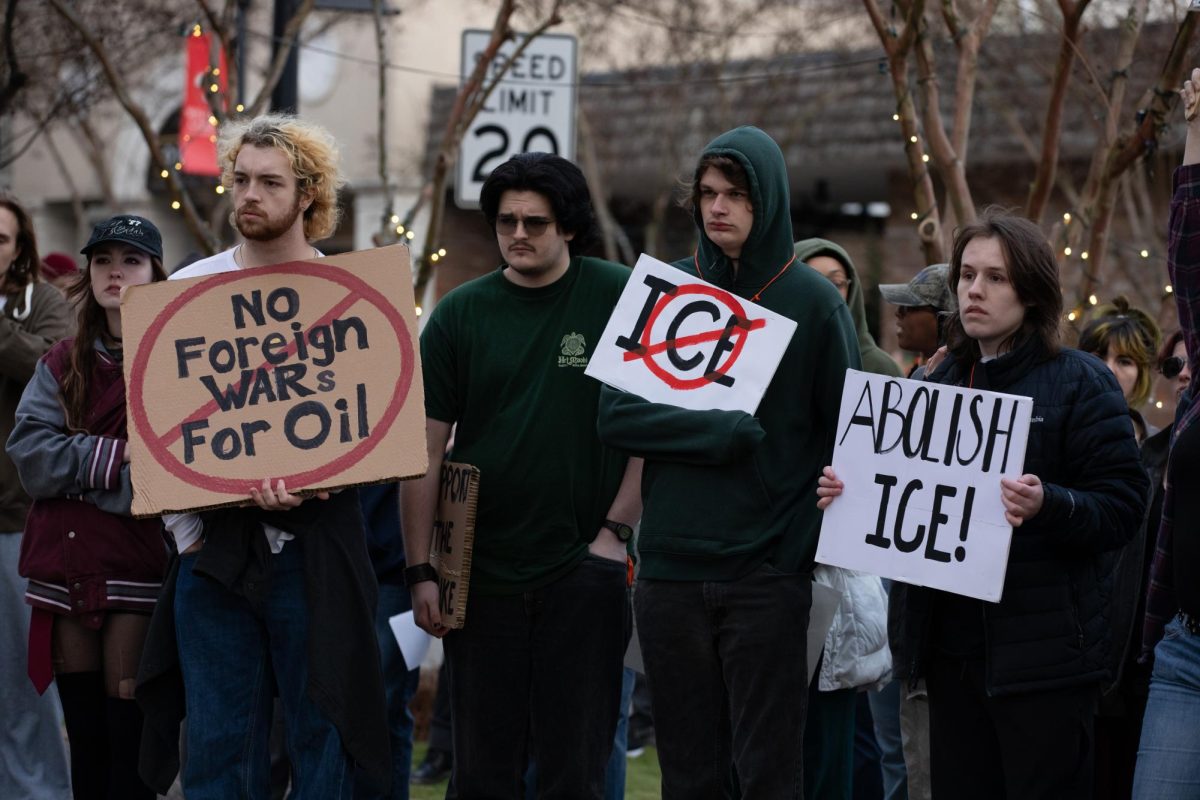
Decades later, the tools of activism have changed, but the urgency and heart have not. Today’s student activists organize not only in classrooms and public squares, but online. Social media allows movements to form almost instantly, spreading information, coordinating protests, and holding institutions accountable in real time. In response to recent ICE raids, students across the country have organized walkouts, blackout days and economic strikes. On Jan. 30, a nationwide strike saw students refusing to attend class or work as an act of protest. Closer to home, students at the University of Southern Mississippi recently marched through the streets of Hattiesburg in solidarity with communities affected by ICE raids in Minneapolis.
As the saying goes, “History tends to repeat itself,” reminding us that student activism is a relentless journey. Student activism shouldn’t serve as a distraction in democracy, but showcases how democracy survives. Whether in the past, present, or the future, the fight is continuous, and students are showing up at the forefront every time.
![Photo collage of DVD posters of Blue Velvet (The Criterion Collection) [Blu-ray]](https://sm2media.com/wp-content/uploads/2026/04/lUabhzYnqCxlgx3pXb7TuifkzRaF1RXRaHr3udNx-1200x675.jpg)