

















A USM student used a 1920s women's fashion catalog to analyze societal expectations of women across decades for the Special Collections item of the month in January.
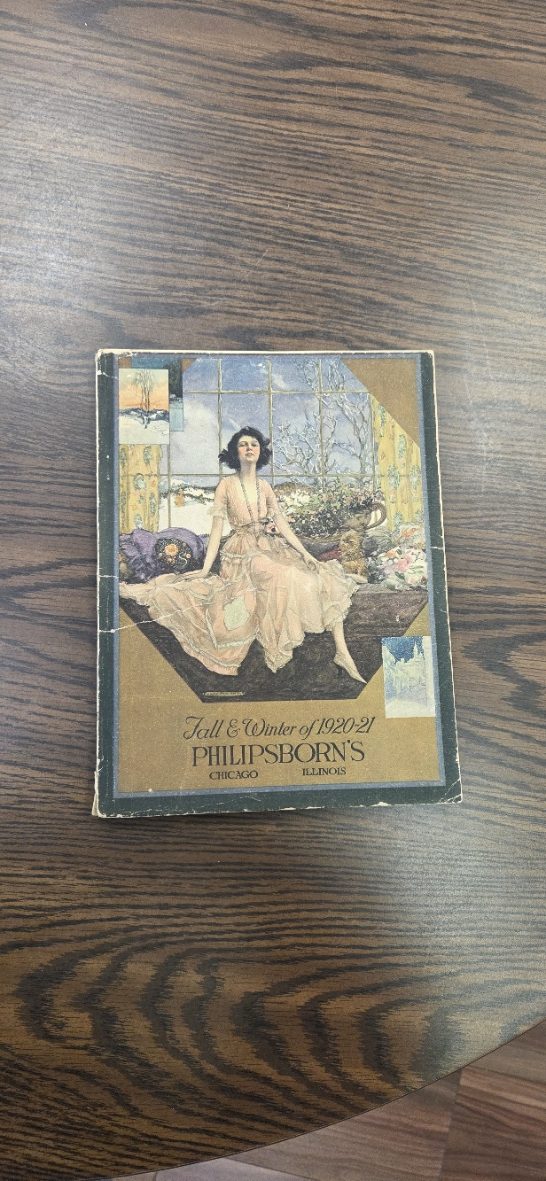
Each month, the University of Southern Mississippi’s Special Collections selects an item from its collection to display. In January, the featured item is Philipsborn's Fashion Catalog from 1920-1921. The biography for the item was written by junior nursing major Angelina Hammonds, who chose to examine how the catalog reflected the body standards for women during the era rather than focusing solely on fashion.
The items of the month featured from 2024 to 2026 are the work of students who took the HON 303 seminar in the fall of 2024 with Jennifer Brannock, curator of rare books and Mississippiana for Special Collections. She assigned students to select an item from the archives and write a biography about it.
Rather than choosing something related to her major, as many students did, Hammonds decided to find something related to one of her many interests. She said she chose the Philipsborn's Fashion Catalog because of its colorful artistic style and the somewhat surprising derogatory language used to refer to plus-size women.
“The illustration of them,” said Hammonds. “They were very thin women, very baggy dresses for dancing, very short hair. And so throughout the book, that's how they were depicted. But the only difference between that picture and the picture used for stout women is that their faces were like a little bit rounder and they had like a little bit more chubbiness… But other than that, there wasn't really that much of a difference between the pictures. So, I thought that was kind of weird, like they just made her face fuller and then the wording that they used.”
When referring to plus-sized women, the author of the catalog used the term “stout women,” a phrase that, while surprising to Hammonds, was not entirely unexpected. She said that throughout the decades, she noticed that the expectations for women’s body shapes have shifted back and forth between an hourglass figure and thinness.
“I would say that, kind of like my research through silhouettes, I kind of got to see just how much. We really have not changed. Like fashion has changed and evolved and different styles and things like that,” said Hammonds. “But I would say that the female silhouette and body types that society expects women to have, it's kind of always stayed within the same narrow spectrum and just going from one end to the other depending on the decade.”
Because of these depictions, Hammonds chose to focus her assignment on the derogatory language that was used in the catalog and how societal standards for women have changed over time in the fashion industry. She examined how women were portrayed throughout the years rather than viewing the item as simply a clothing magazine.
“With her item of the month that she did about the fashion catalog, she really looked at different topics, and she looked at how it covered plus-size clothes,” said Brannock. “And that was a really unique way to look at that item because most people would have looked at it as, ‘this is a bunch of fashion’ rather than honing in on something specific.”
For Hammonds, the catalog represented more than clothes. It was the artwork of the item that stood out to her, which reflected one of her favorite art styles, Art Nouveau, which is known for being bright and colorful. Hammonds referred to the assignment as a passion project, an opportunity for her to research something that she was interested in and could learn more about.
“I think it's a very interesting piece and there are some very beautiful pieces that, that I saw in that catalog that I actually took pictures of that, I thought were gorgeous and I just love them,” said Hammonds. “So, when I saw this catalog, it reminded me of Art Nouveau style, and it was kind of set in the same time period. So, I thought it was, I don't know, I just kind of fell in love with the color cover. It's very beautiful to me.”
Some may look at this item and see outdated clothing or a reflection of societies sexist expectations, but Hammonds sees more than just fashion; she sees art and what she described as a bookmark in time that depicted societal expectations during that time in history and the standards that change with each new decade.
Going into the assignment, Hammonds said that she wasn’t very surprised by the derogatory language used, as she was aware of how women were often viewed during that time. However, she was surprised by how direct the language was in how it described plus-sized women. She stated that the author described the clothes made for these women in such a way as though he was doing the women a favor just by making clothes that would fit them.
But despite the derogatory language used within the catalogue, Hammonds believes that the catalog is not something to be erased or taken to heart.
“This has been happening for a while. It's just kind of changed and evolved with the times, but it's always kind of been something that's been there. So, I think that it was important for people to see that,” said Hammonds. “Also, while this catalog had a specific audience in mind and had plus-size women kind of as a footnote, literally a footnote at the bottom of the page that. It's still important to preserve this history, and you can still appreciate the art in a way, even though it's problematic. It's highly problematic, but it's important to still have.”
Brannock’s mission is for the items within USM’s Special Collections to be preserved in a way that allows them to be easily accessible to students and faculty to assist in their research. The archive houses a wide variety of materials, from children’s literature to rare books to Mississippi history books, including some that involve possible alien abductions. Brannock believes that it is a place in which students can come and see these books, learn from them and use them within their own research.
“This is a resource for them on campus and that even if you don't know what we have or how to use this, that students will feel free to come in and check us out and ask what we have and see how we can help with research. It’s a different way of researching but I think it's more fun than reading what someone else researched,” Brannock said. “So this is a great opportunity for students to come in and look at these documents and come up with their own theories and their own hypotheses without having to rely on a prewritten book.”
In the following months, Special Collections will display two more items of the month created by students. One focuses on the “Laboratory of the Government Chemist,” and the other highlights photographs from the murder of Vernon Dahmer. Special Collections is open Monday through Friday from 9 a.m. to 4 p.m.