


















The University of Southern Mississippi School of Performing and Visual Arts opened its production of “Othello” on Feb. 26 in Tatum Theatre, delivering a powerful and emotionally charged performance of Shakespeare’s tragedy.
The play follows Othello, a military general who secretly marries Desdemona, setting off a spiral of suspicion, manipulation and jealousy. Set in Venice and later Cyprus, the story explores how quickly love and trust can be destroyed by deception.
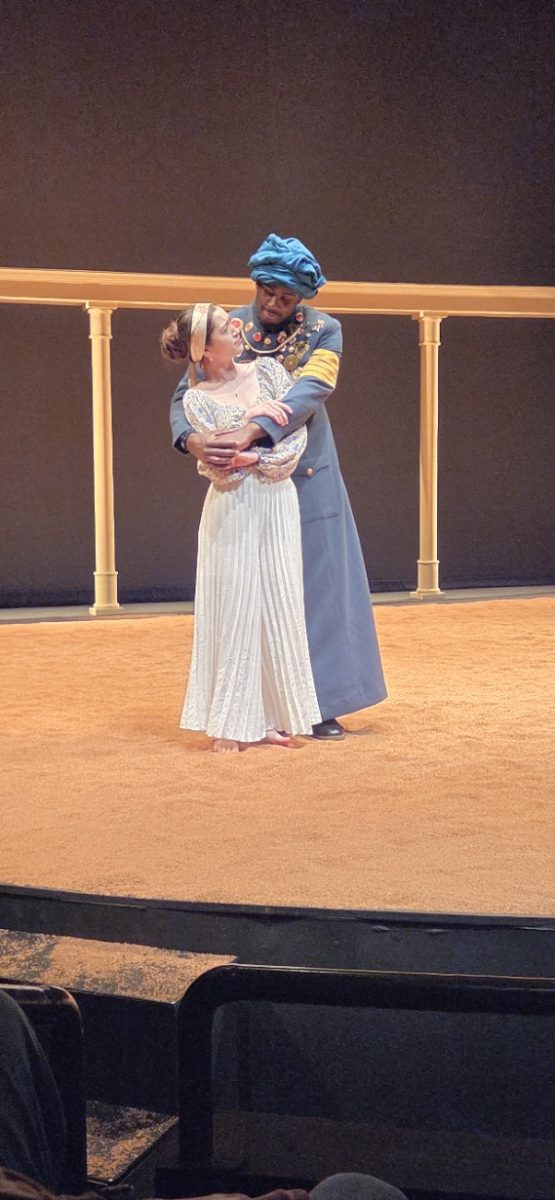
D’Kameron Edmonson, who plays Othello, commanded the stage the second he stepped onto it. Every movement felt deliberate; every word spoken with an air of strength and confidence. In moments, Othello was filled with rage and heartbreak; Edmonson’s performance was physically gripping, from the tremble in his body to the echo of his fists against the stage. I found my eyes drawn to him in every scene, but when Desdemona was on stage, his eyes never seemed to stray from her. This was a small but powerful detail that reinforced the depth of his love for her.
Charlotte Archey’s Desdemona was just as compelling. Their reunion scene, in which Othello lifts and spins Desdemona around the stage with joy, felt tender and genuine. But it was Archey’s portrayal in the final moments that stood out to me. Rather than leaning into an explosive anger at Othello’s betrayal, she played Desdemona’s grief with disbelief, almost annoyance. Her solo near the end was hauntingly beautiful and lingered in my mind hours after the show had ended.
Benaiah Anderson’s Iago was wonderfully detestable. In an era when villains are often written to earn sympathy from the audience, Iago remains unapologetically manipulative and arrogant. You could see the arrogance in every step he took. The way Iago speaks to his wife is enough to make me hate him. But I noticed that it wasn’t just his words that annoyed me; it was his body language, which showed Iago’s true feelings. When his tongue lied, his body told the truth; every movement that Anderson made seemed intentional, and I think that it really added to the evilness of his character.
Jacob Meyers brought an unexpected heartbreak to Roderigo, especially in early scenes where his voice seems to crack with his heartbreaking love and longing for Desdemona. I found it interesting how Shirijal Thapa chose to play Cassio as timid rather than weak, as most did, and grew the character blooming with confidence as the play went on.
Jory Tanaka’s Emilia carried emotional weight, particularly in her later scenes where her anger, loyalty and grief felt raw and genuine. Jaydah-Renee Alexander’s Biance, though her stage time was short, delivered sharp wit and presence that made me yearn for more scenes with her.
The biggest surprise of the night was Elijah Williams as the clown. Traditionally comedic relief, the role was so much more. Williams’ solo, which was not originally part of the play, was unforgettable and, in my opinion, one of the best moments of the night.
While the play went well overall, as the lighting was simple in the first half, becoming more important towards the end, when it became a true focal point being used to highlight and dramatize the tension between the characters. Some of the sounds were occasionally louder and longer than necessary, but what truly confused me was the decision to incorporate modern elements, including cellphones, flashlights, weapons and modern clothing. While some characters like Othello and Emilia wore costumes that reflected the 16th century settings, others, such as Desdemona and other characters like Roderigo and Cassio at some points, wore clothes that felt as if they came out of the ‘50s and ‘70s, to the point where the concept felt only half-committed to.
Still, those distractions never once overshadowed the performances. The cast’s emotional commitment carried the production from beginning to end. From the adorable chemistry of Othello and Desdemona to the Clowns shining solo, which may rival Desdemona’s own solo. Even for those who may not be a fan of Shakespeare, this performance of “Othello” proves to be a strong and bold interpretation of the century-old tragedy.
Audra Williams | Mar 9, 2026 at 4:36 pm
Thank your for the review. Elijah Williams mom