












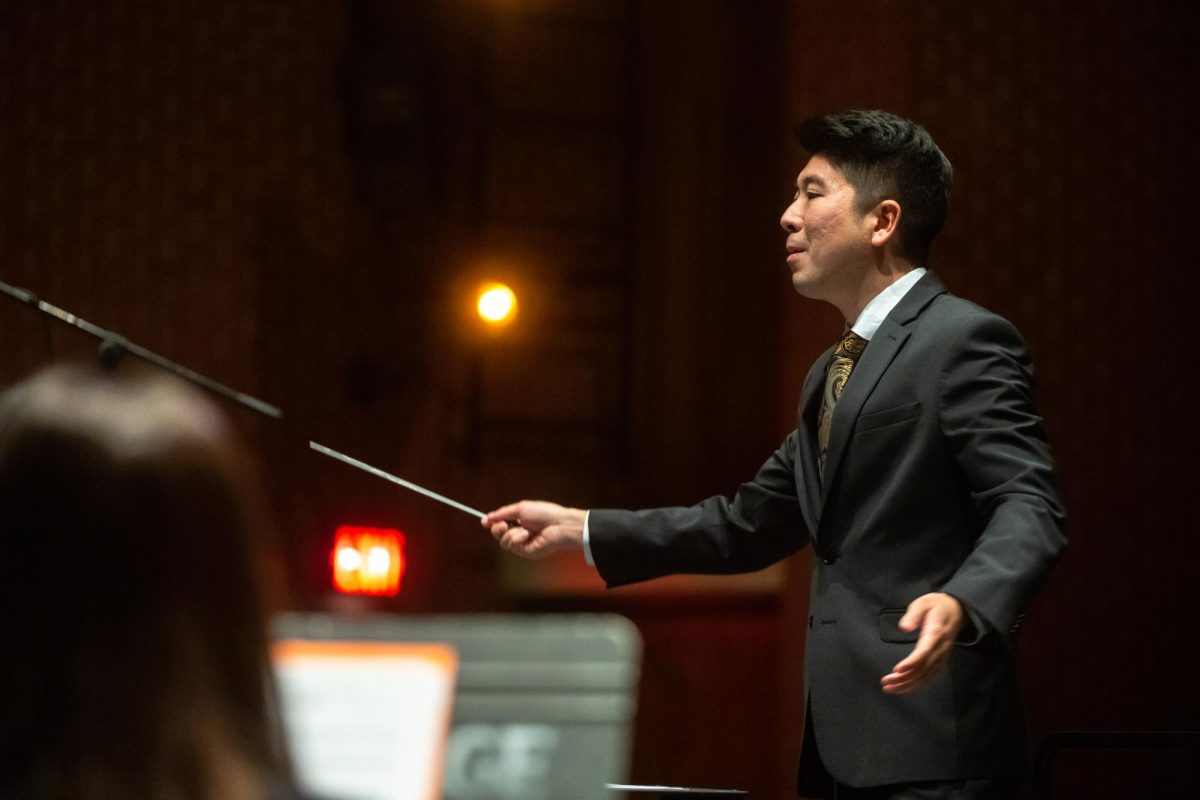
Associate Director of Bands Travis Higa has made diversity the heartbeat of the University of Southern Mississippi bands through composer selections, channeling his multicultural roots into music selections that truly enrich students.
His career has taken him across the country — from teaching in Longmeadow Public Schools in Massachusetts to founding the Youth Wind Ensemble of Springfield and studying how to lead wind bands at Michigan State University while serving on faculty at Oakland University in Michigan. Higa said those experiences, along with growing up in Hawaii, shaped how he approaches music choices.
“I think it’s being exposed to always a pretty diverse background in Hawaii,” Higa said. “And not only that, but then moving all over the United States, it’s helped me just think a little bit more outside the box, naturally.”
That approach also carries into conversations with fellow faculty members. Assistant Band Director Cody Edgerton, who works closely with Higa across several music groups, said their conversations often center on sharing diverse music.
“He and I share ideas with each other about, ‘I really like this piece, you should try it’ and same vice versa,” Edgerton said. “And a lot of times that is music that’s diverse because it’s from a different culture or it comes from a composer who is not white and male.”
That philosophy is reflected in Higa’s programming, where he seamlessly weaves in female composers along with Black, Latino and Japanese voices — broadening students’ exposure to diverse repertoire without making it feel forced.
Edgerton said Higa’s approach also prioritizes true cultural representation in the music students perform — selecting music pieces by composers from those backgrounds rather than works loosely inspired by them.
“We have to be careful because when we write music that’s based on a culture that’s not our own,” Edgerton said. “There’s a lot of things that we can do without knowing that can be harmful — that’s called appropriation.”
If music is written or performed insensitively, he added, it can become a disservice to the tradition it tries to represent. Edgerton noted that Higa makes a strong effort to address this by regularly choosing works from composers of diverse cultural backgrounds.
One example is “Ala,” a piece Higa helped launch the first performance of by composer James David, who lived in Hawaii and studied its culture, drawing on three significant moments in Hawaiian history and translating them into music.
“He did it in a way that was very artistic,” Higa said. “I think that it’s gonna be a part of the art music for a long period of time.”
Higa said the piece stands apart from works that treat culture superficially.
“It’s not just, you know, a unique, special piece,” Higa said. “It’s not just a touristy piece, for lack of better terms.”
For Higa, the value of the work also lies in its educational impact.
“Bringing that music and the history to our students here in Hawaii and being a part of the consortium for that was really important,” Higa said.
Edgerton said this type of programming is valuable because it exposes student musicians to cultures both similar to and different from their own.
“There’s some students sitting in our ensembles who are minorities, who are now seeing, ‘Oh, we’re playing music by someone who looks like me,’” Edgerton said. “That’s a really powerful thing.”
For Higa, exposing students to a wide range of music is an important part of conducting the concert bands. His goal is to introduce them to pieces they may not otherwise encounter and encourage them to form their own reactions.
“They might like this composer, and they might find more pieces of the work,” Higa said. “Or they might say, ‘I hate this music. I never want to perform it,’—which has happened last fall.”
Higa added that music’s personal taste is the point.
“You’re supposed to have a reaction to music,” Higa said. “Whether that reaction is, ‘I love it, it’s fantastic, I want more of it,’ or ‘it’s disgusting, I never want to program it again,’ — I think both of those reactions and feelings are equally important.”
He welcomes the full spectrum of responses.
“I think that both of those reactions will make an impact on our students,” Higa said.