













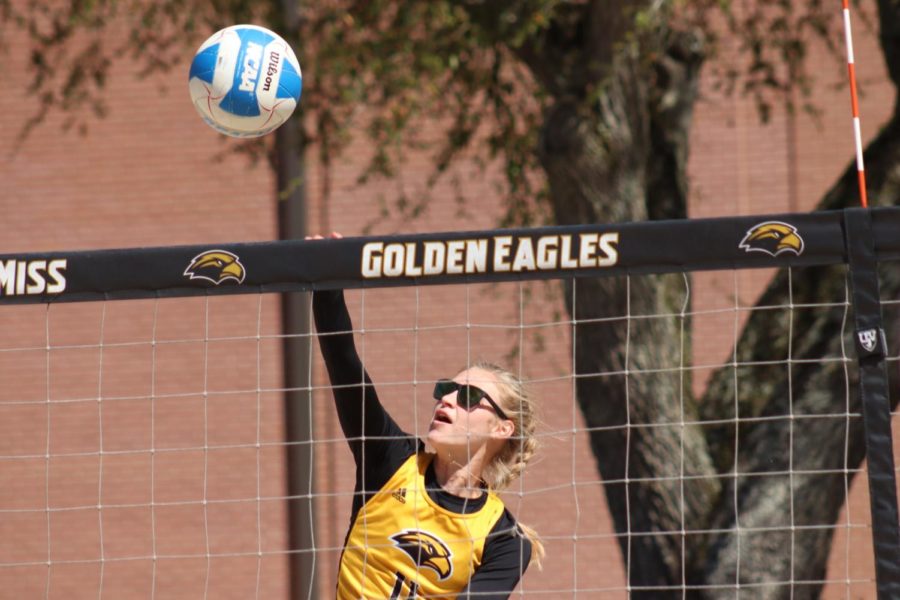

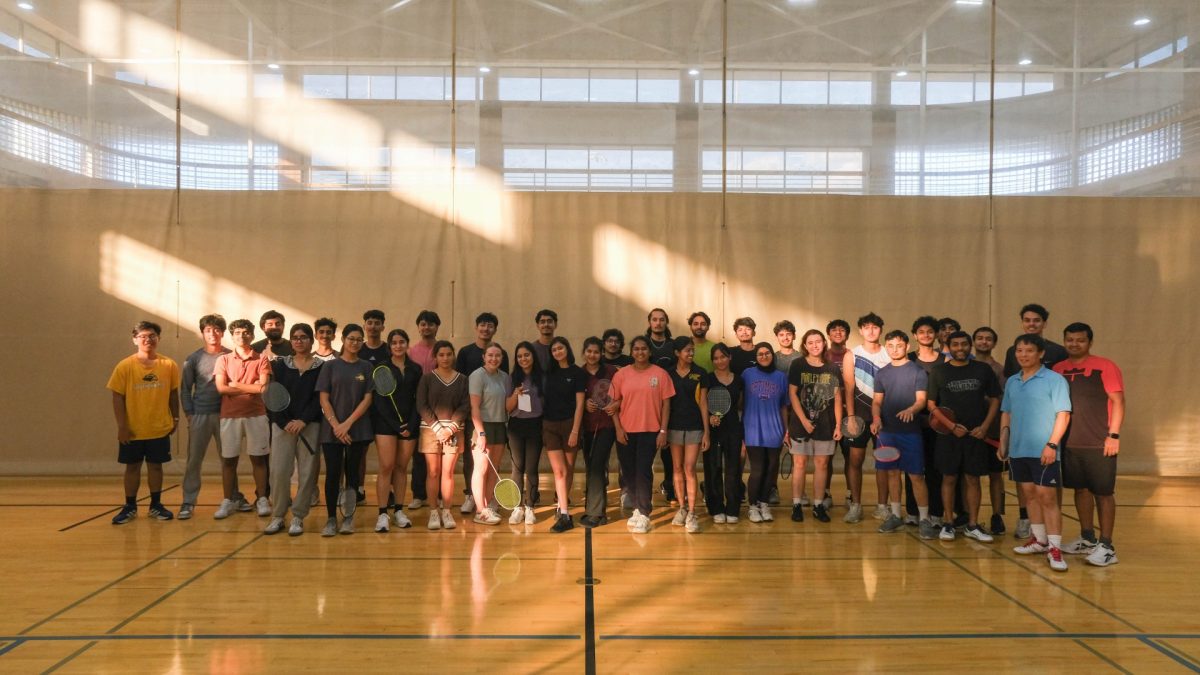
Blending competitive play with an inviting atmosphere, the Southern Miss Badminton Club has become a hub for students seeking both sport and connection on campus. Although it’s a newer club, President Jeevan Karki is already seeing his long-term vision come to fruition.
“Our goal isn’t to be the most popular club; it’s to be the most loved by our members,” Karki said. “We strive to create fun, badminton-related posts and reels on social media, and also participate in campus involvement fairs to meet new people. What truly sets us apart, I believe, is our welcoming nature.”
Badminton is a racquet sport where players hit a high-drag projectile, known as a “shuttlecock,” across a net. It can be played with one player on each side or in “doubles,” where pairs face off against each other, and is very similar to tennis in many ways. Players score points when the opponent commits an error or when they land the shuttlecock on the opposing player’s side within the boundaries. It differs from tennis mainly due to the equipment, a much smaller court and an elevated net. The club plays a best-of-three format, and each game is played to 21 points.
Before coming to Hattiesburg from Nepal, Karki had limited experience with badminton in his childhood, playing on a court at his house. During his freshman year before the club had been established, he came across a match being played at the Payne Center and took advantage of the opportunity to reconnect with the sport.
He began to play regularly. Though he was nervous about interacting with the veteran players, one day he approached a player who was waiting for a partner to play with. It happened to be Dr. Zhaoxian Zhou, who later became the club’s advisor, and the two connected from that point on. Zhou introduced Karki to the other veteran players, marking the early stages of the club’s formation.
“I could see my progress week by week, and so could they. With their constant support, encouragement, and motivation, my game began to improve, and I slowly reached a much higher level,” Karki said. “Even though I was far from their skill level, they never left me out or made me feel like a beginner.”
Over the course of a year, the group would gather three times a week to play. Eventually, they reached a point where they began a push to establish a badminton club. Due to his hard work and dedication, Karki got an opportunity that would impact the rest of his time in college.
“After a year, when we officially formed the USM Badminton Club, more people started joining in. During that time, the group decided to elect me as president because they believed I had the potential to guide and lead the club in the long term,” Karki said. “Their trust and belief in me meant a lot, and I’ve tried my best to live up to it ever since.”
As president, Karki’s day-to-day life ranges from planning special events, such as the recent “Shuttle Up” event that combined badminton with other games, to managing weekly practice schedules. He is aided by his executive team, who ensure that nothing slips by him.
Although the club isn’t currently participating in tournaments with other schools, Karki plans to host a tournament in the spring semester, which would allow students from different schools to play. It would be the first step in collaborating with other universities–a goal Karki has had from the beginning.
From playing at a court at his home as a child to leading a club on a college campus, Karki’s journey with badminton has come a long way. It isn’t just an activity he does when he’s bored anymore–it’s something he commits himself to daily.
“It’s more than just a sport to me; it’s part of my lifestyle now. Whenever I’m having a tough week or things aren’t going right, just thinking about playing on the court puts a smile on my face. The people I’ve met and the friendships I’ve made through badminton at USM mean so much to me,” he said.
For interested students of all skill levels, the best way to get involved with the Badminton Club is to follow their Instagram page or join through Eagle Hub. The club typically plays on Fridays from 4:00 to 6:00 p.m. and Saturdays and Sundays from 2:30 to 4:30 p.m. at the Payne Center.