










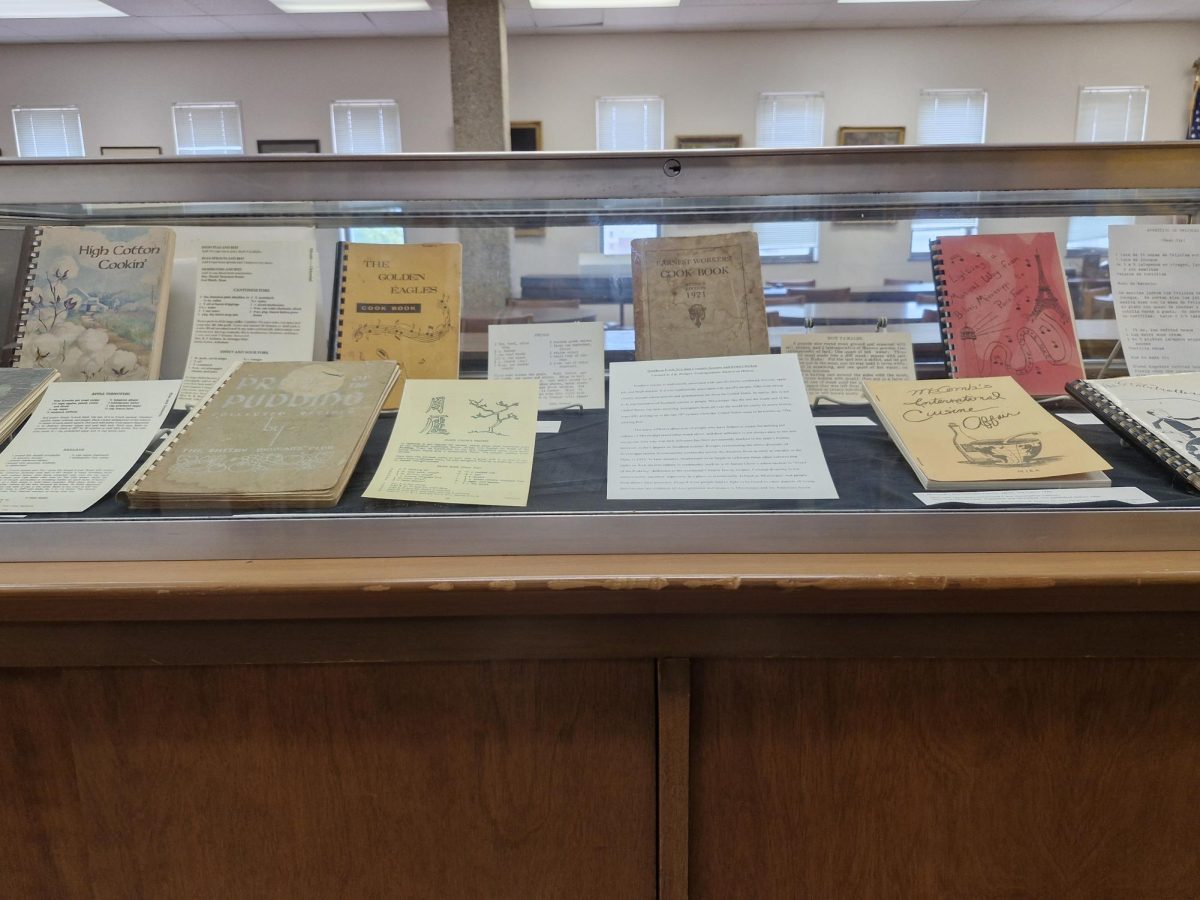
In the 1950s, women’s organizations and churches across Mississippi were publishing cookbooks. Books that reveal a trend toward the increasing use of convenience store foods in America. But tucked between the casserole instructions and the pie crusts, it reveals the fingerprints of women who had more things to say. During a time when literature and publishing were almost exclusively male domains, a recipe collection was one of the few outlets for women.
Today, the University of Southern Mississippi holds the largest collection of these community cookbooks in the world. In archiving the books, they’ve archived the women, too. This is one example of many lives a book collection can capture.
“It [book collection] is a gathering of books,” Jennifer Brannock, professor and rare-books curator at USM, said. “It could be 10 books, or it could be thousands. But any grouping of books is a collection. What defines it is the fact that it’s one person’s.”
So what does it take to start a collection? Brannock says the first step is to find out what you want.
“Find out what your interests are, ” she said. “And then also what your budget is. Because if you’re interested in collecting 15th-century books, that’s going to be a little more expensive than paperback books from the 70s.”
Answering this question is crucial because it shapes the entire collection. Brannock’s own collection has shifted over the years. She went from collecting darker, angsty reads in her college years to cookbooks and pop culture. The collection, like the collector, is allowed to change.
There’s also no threshold for legitimacy. A collection doesn’t need to be rare, expensive, or have a niche. Brannock points out that even books that are collected without much thought, such as course books, fiction and self-help books, add up. They say something about you.
“You can tell a lot by people’s book collection,” she said.
Once you know what you want, the next step is to know where to look. Used bookstores and estate sales are a good starting point. Brannock spends a significant amount of time on eBay, where she has saved searches set up to email her when anything relevant surfaces.
More seasoned collectors use specialized channels. Every Tuesday, rare book dealers send out catalogs through LISTSERV — a marketplace where sellers advertise what their products, like books or other goods. Brannock checks it regularly to buy in and keep track of how the market.
For rarer books, she relies on her relationships with dealers who know what she is looking for and will give her a heads-up when a book she wants surfaces.
“There’s one guy I deal with who handles fringe materials,” she said. “He knows what I am looking for, so he comes back to me.”
Then there’s the price. For a book, it is rarely fixed. Demand drives it up fast. When USM began aggressively collecting the work of Charles Henry Ford, a Mississippi artist and writer from the early 20th century, the market took notice.
“Because we started buying his materials, the price started going up,” Brannock said. “Now they are going for like $1200.”
Some books she is still looking for, she may never be able to find. Brannock tries to buy books by Mississippi authors as soon as they are published. A book that costs $30 could be rare and expensive years later.
“If a very famous Mississippi author comes out with a new book, I try to buy it now,” she said. “Because if I tried to buy it 40 years from now, the price is going to go up.”
This is more or less how you collect a book. All the hunting, LISTERVS and price tracking lead to one thing — a book collection that captures choices made over time, reflecting who you were and who you became.
Brannock says there is only one metric for a good collection. It is simple.
“If it makes the collector happy, then it is a good collection,” she said.