

















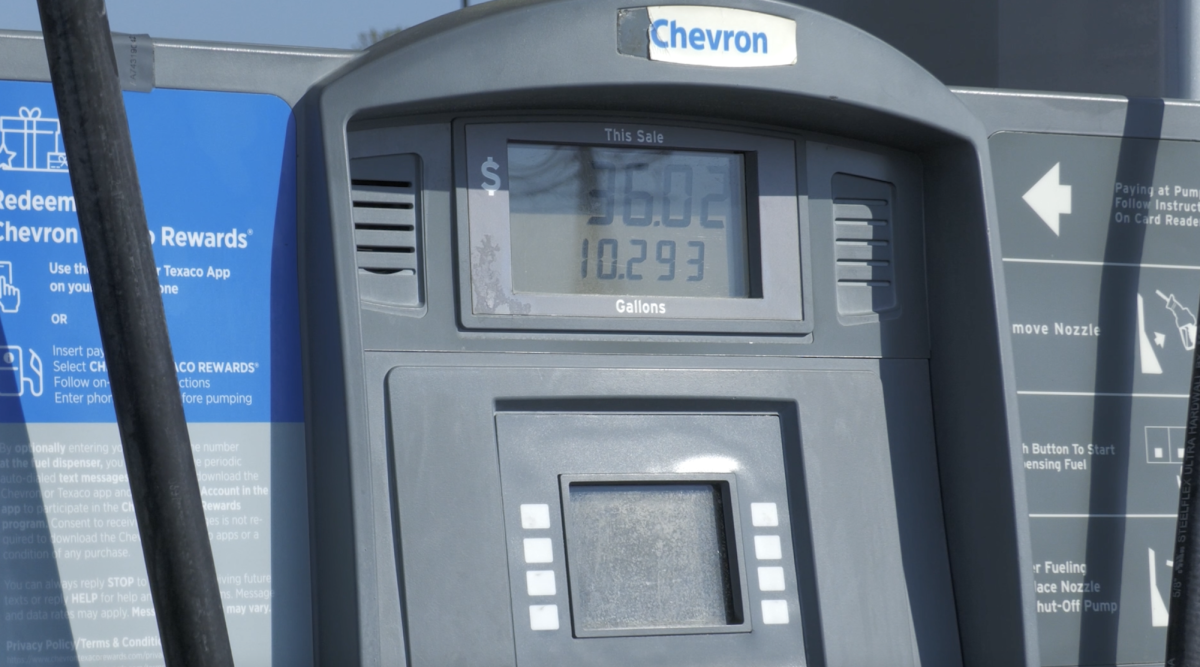
A recent spike in gas prices is making it harder for college students to afford everyday travel, pushing many to cut back on trips home, social outings and other basic expenses.
The price increase follows rising global oil tensions after Iran’s late‑February retaliation against U.S. airstrikes. By threatening to close the Strait of Hormuz and taking military action, Iran created fear for ship safety. This caused tanker traffic to drop sharply, reducing the amount of oil flowing through Hormuz and creating a supply shortage. Markets responded to the uncertainty and lower flow by pushing fuel prices higher in recent weeks, adding pressure on local drivers.
After noticing the jump at the pump —paying about $32 instead of her usual $25, even with two bars left—undergraduate student Darby Felton worries about the rising costs.
“It does worry me a lot about what’s going on and what’s causing these gas prices to rise,” Felton said.
To keep up with the added cost, Felton said she had adjusted her budget, setting aside extra money for gas.
“I just take about 15 extra dollars out of my rent, well out of my paycheck to put towards that,” she said.
Felton also shares transportation costs with the people she lives with, rotating who drives and splitting gas expenses. Still, she said the cost of gas affects how often she goes out.
“I really don’t like go out to parties, but I like save that time and the gas just to go and visit my mom on the coast,” she said.
Other students are finding different ways to adapt.
Sophomore Clayton Sartor, who commutes 100 miles round-trip a day, said he managed costs by bundling errands and using grocery delivery. Filling his truck now costs $30 extra per trip—once or twice weekly—but he uses Shell/Chevron rewards for 15-20 cents off per gallon.
“I’m just having to adjust,” he said.
For students who live even farther from campus, the impact can be even greater. Junior Ahkia Edwards, who relies on her mom for transportation, said the rising costs mean timing trips more carefully, including visits to the coast. She added that sometimes it also means cutting back on other spending, like meals out with friends.
“If someone’s like, ‘hey, you want to go out?’ I’m like, ‘oh, you know, I’m trying to save money on gas…So, maybe another time,” Edwards said.
She said the rising costs don’t just affect social plans but also make trips harder to coordinate with her mom.
“It does make it a little bit trickier to plan trips…” Edwards said. “We do put more consideration than we usually would do if it was just… if the gas prices hadn’t gone up.”
As prices rise, Edwards plans to set aside part of her budget for gas and keep extra money on hand.
“I do like to keep — make sure I have 20 or 30 on me just to be safe… because…even when I do come back home, I’m not just staying home,” she said.
She also balances these financial concerns with her mother’s health needs. Her mother requires dialysis treatments three times a week at a clinic 20 to 25 minutes away. Because of that, they try to keep at least $20 reserved for gas.
The added strain has left Edwards feeling uneasy, though she holds out hope that prices will drop soon, as they did after the pandemic.
“She’s constantly going back and forth to the clinic, and it adds up,” Edwards said. “It does make me a little uneasy because I know how much she does need that car.”
That budgeting pressure intensifies on a fixed income.
“Being on a fixed income, it’s not easy…,” Edwards said. “What if a different expense pops up and you’re just kind of stuck because you’re like, ‘I need this for this expense, but I also need this for gas.’”