


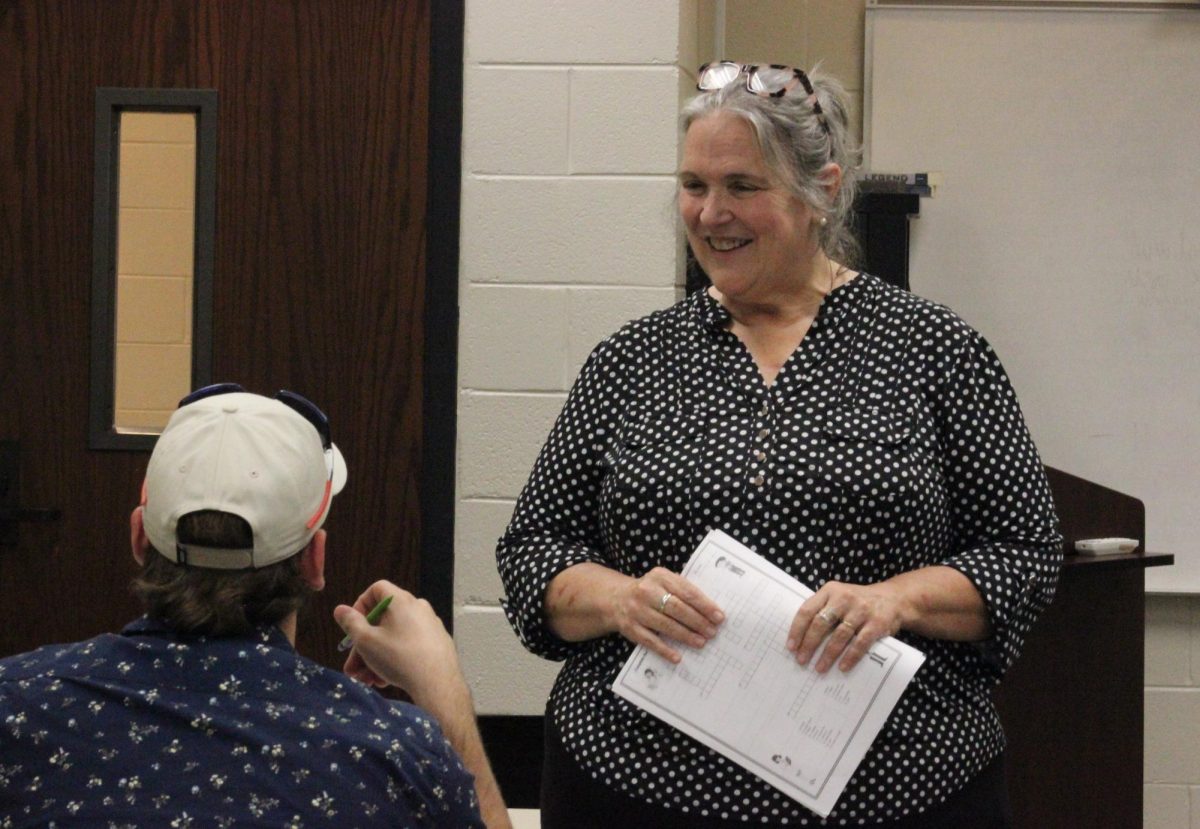















The School of Social Sciences and Global Studies hosted Dr. Shelley Volsche from the University of Mississippi for a lecture on April 9. Volsche delivered a speech about the bond between people and their pets, which analyzed how it differs between parents and non-parents among different cultures.
Volsche is an applied anthropologist and ethologist who is also a certified dog trainer. Her work focuses on human-canine coevolution, cross-cultural comparisons of pet keeping and interspecific attachment. Her lecture at Southern Miss focused specifically on how the bond between humans and their pets varies between people with and without children. Her talk considered different demographic factors like age, sex and education, in addition to parental status. The talk was based on several of her research papers.
Volsche’s talk featured pet parenting, its rising popularity with the child-free lifestyle and the application of parenting techniques on pets. She defined pet parenting as an investment of time, emotion and money into companion animals that mirrors parental investment in children. She also talked about cooperative breeding, a social system where individuals beyond a pair’s parents assist in raising offspring. She hypothesized that, as we see less fertility and less cooperative breeding because of people being far away from their families, people replace the need to nurture another being with their pets.
Volsche got her data through a survey, which was sent to different countries. The survey was translated and adapted for different cultures, adjusting and omitting questions where needed. Through the surveys, she found out that non-parents showed higher rates of people substituting with their pets than parents. Non-parents also showed stronger general care toward the pets than parents. Both groups, however, showed equal involvement in training and play. Volsche hypothesized that the other factors could be weaker in families with children because children were fulfilling some parts of the relationships in place of pets.
“It is a topic that we thought would have a broad appeal because people like animals, and it seems like a timely topic that is relevant to a lot of people,” Sharon Young, an assistant professor in the anthropology department, said. “There are lots of community cats here, and lots of people have cats.”
After her work with parenting techniques in pets, Volsche plans to do more in-depth research on both humans and pets.
“I have two things going on; I have a pilot paper out already about dog laugh,” Volsche said. “Another thing I am looking at is the impacts of being a behavioral professor in the animal shelter world.”